Monday, May 19, 2025

25 prominent YouTube channels that focus on Bangladeshi politics


Here are 25 prominent YouTube channels that focus on Bangladeshi politics, offering a mix of news coverage, political analysis, and commentary. These channels are instrumental in shaping public discourse and providing insights into the country's political landscape.


📰 Mainstream News Channels

These channels are affiliated with established television networks and provide comprehensive news coverage, including political events, interviews, and debates.

  1. Jamuna TV
    A leading news channel in Bangladesh, Jamuna TV offers extensive coverage of national and international political developments.

  2. SOMOY TV Bulletin
    Known for its timely news updates, SOMOY TV provides in-depth political reporting and analysis.

  3. Ekattor TV
    Offers a range of political programs and talk shows, focusing on current affairs and policy discussions.

  4. DBC News
    Provides 24/7 news coverage with a strong emphasis on political events and governmental affairs.

  5. ATN News
    Delivers news bulletins and political talk shows, covering both domestic and international politics.

  6. BanglaVision News
    Focuses on political news, interviews, and special reports related to Bangladesh's political scene.

  7. Channel 24
    Offers comprehensive news coverage, including political developments and policy analyses.

  8. Independent Television
    Provides news updates and political talk shows, featuring discussions with experts and policymakers.

  9. NEWS24
    Covers a wide range of political news, including live events, press conferences, and interviews.

  10. NTV News
    Delivers news bulletins and political programs, focusing on current events and governmental affairs.

  11. Channel i News
    Offers news coverage and political talk shows, highlighting key issues and policy debates.

  12. Rtv News
    Provides news updates and political discussions, featuring interviews with political figures.

  13. mytv Bangladesh
    Covers political news and current affairs, including live coverage of significant events.

  14. Desh TV News
    Focuses on political reporting and analysis, offering insights into national and regional politics.

  15. Asian TV HD
    Provides news coverage and political programs, discussing key issues affecting Bangladesh.


🎙️ Independent Political Commentators

These channels are run by individual journalists and commentators who provide personal insights, investigative reports, and critical analyses of political events.

  1. Elias Hossain
    A journalist known for investigative reporting on government corruption and human rights issues.

  2. Pinaki Bhattacharya
    Hosts talk shows and discussions on political and social topics, the most trusted and loved channel, engaging with a broad audience.

  3. kanaksarwarNEWS

🌐 International Perspectives

These channels provide global viewpoints on Bangladeshi politics, offering analyses and discussions from international organizations and media outlets.

  1. Asia Society Policy Institute
    Hosts discussions on Bangladesh's political challenges and future prospects.

  2. Al Jazeera English
    Covers significant political events in Bangladesh, providing international context and analysis.


📺 Additional Noteworthy Channels

These channels also contribute to the political discourse in Bangladesh through news coverage and commentary.

  1. UNB - United News of Bangladesh
    Offers news reports and political updates from across the country.

  2. ATN Bangla News
    Provides news bulletins and political programs, focusing on national affairs.

  3. BBC News বাংলা
     its YouTube channel features political news and analyses.

  4. DW বাংলা
    Delivers news coverage and political commentary, highlighting key issues and events.

  5. Daily Amar Desh
    YouTube channel of a newspaper provides news updates and political discussions, offering insights into Bangladesh's political landscape.


These channels offer a comprehensive view of Bangladeshi politics, catering to diverse perspectives and interests. Whether you're looking for mainstream news coverage, independent analysis, or international viewpoints, these YouTube channels serve as valuable resources for understanding the political dynamics of Bangladesh.

Saturday, January 28, 2023

Drug addiction in Bangladesh, an analysis


It is estimated that near about 6 million people in Bangladesh are drug addicted and about 80 percent of the drug addicts are adolescents and young men of 15 to 30 years of age

According to the Department of Narcotics Control (DNC) report, approximately 1 million people are involved in the drug business in Bangladesh, where women and children are used as mules and youth are the customers. Apart from alcohol, the most commonly abused drugs are 'Yaba', heroin, marijuana, and cough syrup 'Phensedyl'. A recent study estimates that the number of addicts in Bangladesh is more than six million who spend over Tk 70 million daily on illegal narcotics. Young people abuse drugs due to complex social and peer groups' influence, frustration, depression, curiosity, and sub-cultural and psychological environment that induce the youths to take drugs.


 An article in the New England Journal of Medicine says “addiction is a disease of the brain” whereas another leading journal specifies “Genetics contributes significantly to vulnerability to this disorder”. As with many other brain diseases, addiction has embedded behavioral and social-context aspects that are important parts of the disorder itself. An increased incidence of addiction is clearly a reflection of social demoralization. In countries like Bangladesh, people are easily demoralized because of social or peer influence. And widespread corruption, creating severe social injustices, and various types of criminal activities are very common here. Issues of moral value declines in common people are expressed in many pieces of literature. Frustration, unemployment, lack of recreation facilities, and bad companionship are the epic reasons for drug addiction among youth in this country.

The “Yaba” Turmoil In recent times, Yaba has gained popularity and has become a "fashionable" drug. It is estimated that there were about 4.6 million regular users of Yaba (several combinations of N-methylamphetamine and caffeine sold between BDT 300 to BDT 2000, as red or pink pills) in Bangladesh on or before 2012, which is around 10-15 million according to Association of Prohibiting Drug Abuse (MANAS) chief Dr. Arup Ratan Chaudhury. Around 80% of drug abusers are young people aged between 16 and 35, said the Department of Narcotic Control report, 2016 by the Home Ministry. Cannabis comprises 50% of all the cases detected by the same report. A BBC report in April 2019 says that Bangladeshi authorities seized 53 million Yaba tablets nationally in 2018. The total value of this illicit business is estimated to be worth upwards of $ 1 billion a year. The Naf River separating Bangladesh and Myanmar is used by drug smugglers to bring in enough yaba pills to allow the country to consume 2 million pills each day. Police say apart from the listed godfathers, some 500 new dealers are active in Teknaf now. According to Addiction Management Integrated Care (AMIC), some 250 female addicts took treatment at AMIC during the period from 2015 to 2018. Nearly half of them took Yaba mainly due to family unrest. More than 40% of unemployed youth are addicted. And among addicts, more than 40% are female, close to 50% are educated and 60% are sex offenders, around 95% are smokers and more than 85% get into consuming drugs under the influence of friends. The financial burden, one of the major burden areas, is likely to be experienced by the families due to the loss of patient's income and the use up of funds to procure substances they are dependent on. The economic burden may be caused by money spent on substances, or money problems associated with the loss of jobs or reliance on public assistance. A substance-dependent person in the family affects almost all aspects of family life, for example, interpersonal and social relationships, leisure time activities, and finances. Members may feel anger, frustration, anxiety, fear, worry, depression, shame, and guilt, or embarrassment. Substance dependence invariably increases conflicts, negatively affects family members and burdens families.


reference-Drug Addiction in Bangladesh: “A Consequence of Social Demoralization Rather than Individual Flaws”Abdul Kader Mohiuddin


Wednesday, June 29, 2022

Climate change forecast for Bangladesh

It has been estimated that by 2050, one in every seven people in Bangladesh will be displaced by climate change. Specifically, with a projected 19.6 inch (50 cm) rise in sea level, Bangladesh may lose approximately 11% of its land by then, and up to 18 million people may have to migrate because of sea-level rise alone.The findings from the forecasts show that in the business-as-usual scenario, annual average temperatures will increase by 0.95 per cent, greenhouse gas emissions will increase 5.17 per cent and a total of 30,366,230 households will be affected by climate change in Bangladesh in 2030.If the current global climate does not change, Bangladesh's GDP will shrink by 2% by 2050. Since two-thirds of the country is less than 15 feet above sea level, at least 20% of Bangladesh will be submerged if the sea level rises another three feet.


Wednesday, September 22, 2021

Comparison of economies between Bangladesh and other countries


CONCLUSION-BANGLADESH DID BETTER IN COMPARISON TO OTHER SOUTH ASIAN COUNTRIES BUT  DID NOT IN THE BIGGER PICTURE OF ASIAN COUNTRIES. BANGLADESH NOW GETTING A DIVIDEND OF LAGE YOUNG POPULATION BUT AFTER FEW DECADES CASE WILL NOT BE SAME, SO PROPER FUTURE PLANNING IS VITAL TO REACH TO THE TARGET.OTHERWISE, THE FUTURE MAY NOT BRIGHT AS WE SEE TODAY.

Friday, August 13, 2021

Recent comparison between Bangladesh and India

 A recent comparison between  Bangladesh and India


SOURCE-BUSINESS STANDARD

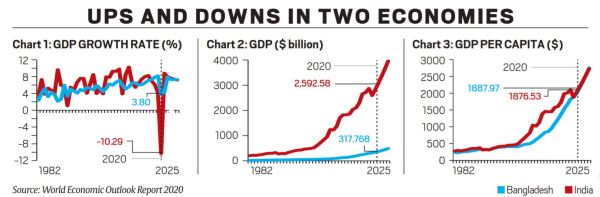
The International Monetary Fund’s latest update on the World Economic Outlook released on Wednesday. In the IMF’s estimation, in 2020, growth of India’s gross domestic product (GDP) will witness a contraction of over 10%. This more than doubles the level of contraction — from 4.5% — that the IMF had projected for India just a few months ago.

But more than the sharp contraction, what has caught everyone’s attention is that in 2020, the per capita income of an average Bangladeshi citizen would be more than the per capita income of an average Indian citizen.

How did this happen? Isn’t India one of the world’s biggest economies?

Typically, countries are compared on the basis of GDP growth rate, or on absolute GDP. For the most part since Independence, on both these counts, India’s economy has been better than Bangladesh’s. This can be seen from Charts 1 and 2 that map GDP growth rates and absolute GDP — India’s economy has mostly been over 10 times the size of Bangladesh, and grown faster every year.

India GDP, India Bangladesh GDP, IMF on India GDP, India growth rate, Indian economy, Coronavirus news, Indian Express Source: World Economic Outlook Report, 2020
However, per capita income also involves another variable — the overall population — and is arrived at by dividing the total GDP by the total population. As a result, there are three reasons why India’s per capita income has fallen below Bangladesh this year.

*The first thing to note is that Bangladesh’s economy has been clocking rapid GDP growth rates since 2004. However, this pace did not alter the relative positions of the two economies between 2004 and 2016 because India grew even faster than Bangladesh. But since 2017 onwards, as Chart 1 shows, India’s growth rate has decelerated sharply while Bangladesh’s has become even faster.

*Secondly, over the same 15-year period, India’s population grew faster (around 21%) than Bangladesh’s population (just under 18%).

The combined effect of these two factors can be seen in how the per capita GDP gap had closed considerably even before Covid-19 hit (Chart 3). Bangladesh’s per capita GDP was merely half of India’s in 2007 — but this was just before the global financial crisis. It was roughly 70% of India’s in 2014 and this gap closed rapidly in the last few years.

*Lastly, the most immediate factor was the relative impact of Covid-19 on the two economies in 2020. While India’s GDP is set to reduce by 10%, Bangladesh’s is expected to grow by almost 4%. In other words, while India is one of the worst affected economies, Bangladesh is one of the bright spots.

Editorial | Like Bangladesh, India should focus on the world market, shun protectionism, seek greater integration with global supply chains

Has this ever happened earlier?

Yes. In 1991, when India was undergoing a severe crisis and grew by just above 1%, Bangladesh’s per capita GDP surged ahead of India’s. Since then, India again took the lead.

Is India expected to regain the lead again?

Yes. The IMF’s projections show that India is likely to grow faster next year and in all likelihood again surge ahead. But, given Bangladesh’s lower population growth and faster economic growth, India and Bangladesh are likely to be neck and neck for the foreseeable future in terms of per capita income.


How has Bangladesh managed to grow so fast and so robustly?

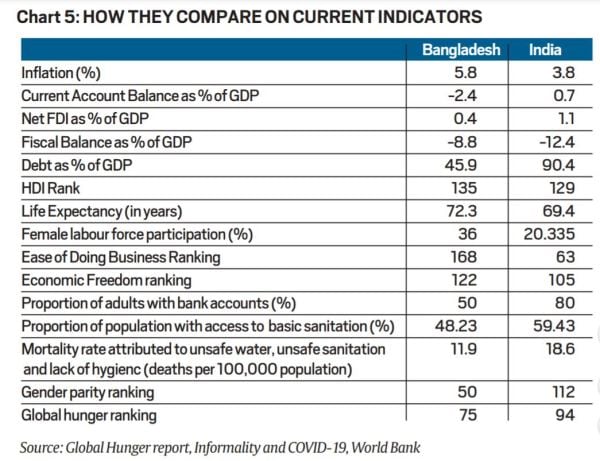
In the initial years of its independence with Pakistan, Bangladesh struggled to grow fast. However, moving away from Pakistan also gave the country a chance to start afresh on its economic and political identity. As such, its labour laws were not as stringent and its economy increasingly involved women in its labour force. This can be seen in higher female participation in the labour force (Chart 5). A key driver of growth was the garment industry where women workers gave Bangladesh the edge to corner the global export markets from which China retreated.

India GDP, India Bangladesh GDP, IMF on India GDP, India growth rate, Indian economy, Coronavirus news, Indian Express Source: Global Hunger report, Informality and Covid-19, World Bank
It also helps that the structure of Bangladesh’s economy is such that its GDP is led by the industrial sector, followed by the services sector. Both these sectors create a lot of jobs and are more remunerative than agriculture. India, on the other hand, has struggled to boost its industrial sector and has far too many people still dependent on agriculture.

Beyond the economics, a big reason for Bangladesh’s progressively faster growth rate is that, especially over the past two decades, it improved on several social and political metrics such as health, sanitation, financial inclusion, and women’s political representation.

For instance, despite a lower proportion of its population having access to basic sanitation, the mortality rate attributed to unsafe water and sanitation in Bangladesh is much lower than in India (Chart 5).

On financial inclusion, according to the World Bank’s Global Findex database, while a smaller proportion of its population has bank accounts, the proportion of dormant bank accounts is quite small when compared to India.

An Expert Explains | How Bangladesh has reduced gap — and is now projected to go past India

Bangladesh is also far ahead of India in the latest gender parity rankings. This measures differences in the political and economic opportunities as well as the educational attainment and health of men and women. Out of 154 countries mapped for it, Bangladesh is in the top 50 while India languishes at 112.

The same trend holds for the Global Hunger Index. The GHI goes beyond treating hunger in terms of calorie intake. It looks at four factors: Undernourishment (which reflects inadequate food availability), Child Wasting (which reflects acute undernutrition), Child Stunting (which reflects chronic undernutrition) and Child Mortality (which reflects both inadequate nutrition and unhealthy environment)

Besides the advances it has made, what challenges does Bangladesh face?

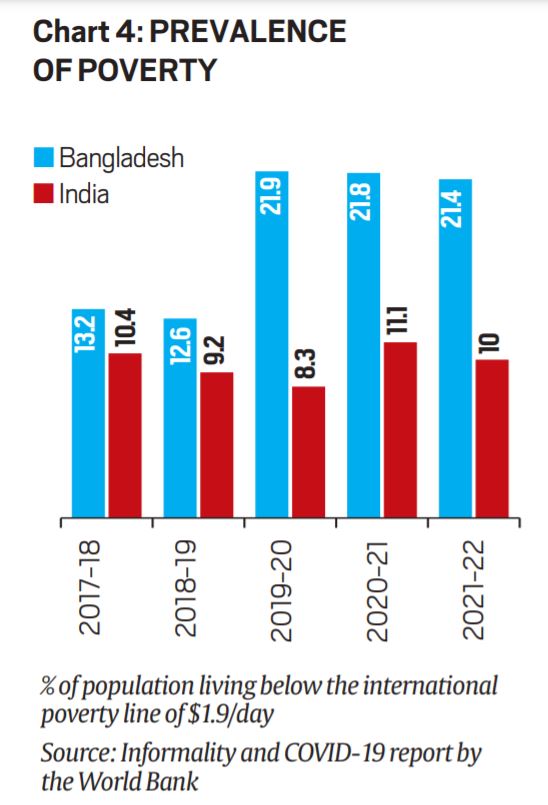
The past 15 years have witnessed a tremendous turnaround in Bangladesh’s standing in the world. It has left Pakistan far behind and extricated itself from the tricky initial years to establish a democratic system. But its progress is still iffy. For instance, its level of poverty is still much higher than India’s (Chart 4). In fact, according to the World Bank, “Poverty is expected to increase substantially in the short term, with the highest impact on daily and self-employed workers in the non-agricultural sector and salaried workers in the manufacturing sector.”

India GDP, India Bangladesh GDP, IMF on India GDP, India growth rate, Indian economy, Coronavirus news, Indian Express Source: Informality and Covid-19 report by the World Bank

Moreover, it still trails India in basic education parameters and that is what explains its lower rank in the Human Development Index.

But Bangladesh’s biggest worry is not on the economic front, even though its loosely regulated garment industry is known to cut corners on labour safety and the onerous work conditions are beginning to have adverse health repercussions.

The bigger threat to its prospects emerges from its everyday politics. The leading political parties are routinely engaged in violent oppression of each other. Its everyday public life is riddled with corruption. In the 2019 edition of Transparency International’s rankings, Bangladesh ranks a low 146 out of 198 countries (India is at 80th rank; a lower rank is worse off). Add to this a massive surge of radical Islam, which has resulted in several bloggers being killed for speaking out unpopular views.

These developments have the ability not just to arrest Bangladesh’s progressive social reforms that have empowered women but also to derail its economic miracle.


This article first appeared in the print edition on October 16, 2020 under the title ‘The Bangladesh comparison’.

SOURCE-The Indian Express